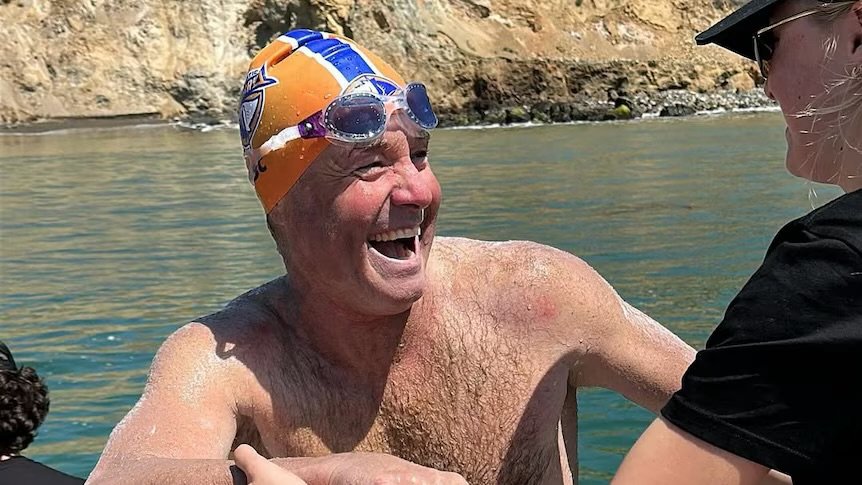
A Los Angeles beach is about as big a change in scenery from far west New South Wales as you can get. For Brendan Cullen, a grazier from Kars Station more than 1,000 kilometres west of Sydney, the shift from the dry, dusty outback to the shimmering Pacific coastline of Southern California was dramatic — but it didn’t daunt him. It was here, along the iconic Southern Californian coastline, that Cullen achieved yet another extraordinary sporting feat: swimming the 32.3-kilometre Catalina Channel from Santa Catalina Island to the US mainland. “It was bloody good to get it done,” Cullen told ABC Broken Hill, his quiet satisfaction revealing the culmination of months of relentless training and preparation. The Catalina Channel swim is far from a casual dip in the ocean. The 32.3-kilometre stretch of water is renowned among the open water swimming community for its demanding conditions, requiring both physical endurance and mental toughness. For Cullen, a seasoned swimmer with prior English Channel crossings under his belt, the challenge was as much about strategy as it was stamina. The majority of the over 13-hour swim was undertaken in the dark. This was a deliberate choice to avoid the notorious afternoon winds that can whip up along the channel. Cullen described the conditions as “magnificent,” with calm waters and temperatures hovering around 22 degrees Celsius — a far cry from the frigid waters of the English Channel, which can hover around 15 degrees or lower. “One of the things that I’ll never forget was the bioluminescence in the water,” he said. “Every time your hand hit the water, it would just flash like a rainbow. It was unbelievable. And every now and again, you could see the bottom of the ocean just flicker, and it was like the stars underneath.” The imagery paints a magical scene: a night swim under a sky mirrored by the shimmering ocean, where every stroke illuminated the water with ephemeral light. For Cullen, it was not just a physical challenge but an experience of natural wonder. Preparation for such an extraordinary endeavor is never simple, and Cullen’s training grounds couldn’t have been more different from the Pacific Ocean. Back in New South Wales, he trained at Menindee Lakes and the Broken Hill pool. While both locations are considerably devoid of waves, they were nonetheless sufficient to ready him for one of open water swimming’s most coveted accolades — the Triple Crown of Open Water Swimming, which includes the English Channel, Catalina Channel, and Manhattan Island Marathon Swim. Cullen’s journey towards the Triple Crown has been marked by impressive achievements. He first conquered the 33-kilometre English Channel solo in 2022, before taking it on again in 2023 as part of a relay team. These feats required months of preparation, resilience, and a capacity to adapt to the harsh conditions of open water. “The English Channel swims were far more challenging than the Catalina Channel,” Cullen explained. “Even though the US and English channels are of similar lengths, the water temperature in the English Channel made the swim significantly harder. It took me four hours longer to complete than Catalina. Even at night, the US waters were significantly warmer than the freezing stretch of water between England and France.” Training in the relatively tame waters of Menindee Lakes and a pool might not seem equivalent to the open ocean, yet Cullen’s preparation emphasized endurance, pacing, and mental fortitude — all essential for a successful channel swim. Support systems are critical in open water swimming, where physical and psychological challenges intersect. Cullen’s journey was no exception. His friend, coach, and mentor Mike Gregory accompanied him for the Catalina Channel swim. Initially planning to swim tandem with Cullen, Gregory made a remarkable sacrifice mid-swim. “He was getting in front of me and then dropping behind me, and he was cooling down, and he wasn’t quite sure whether he was going to be able to maintain that,” Cullen said. “So, he opted to get out and basically sacrificed his swim for mine. Which is a hell of a thing to do.” Left to swim solo, Cullen was supported by his family — his wife Jacinta and daughters Emma and Charli — who accompanied him in a boat. Their presence provided not only logistical support but also a vital emotional anchor. In open water swimming, especially long-distance challenges like Catalina, family and crew are more than spectators; they are lifelines. They monitor nutrition, hydration, and safety while providing motivation and reassurance, which can be as crucial as any physical training. While physical preparation is undeniably important, mental toughness defines success in channel swimming. Cullen’s ability to maintain focus, pace, and calm throughout the long night swim was integral to his achievement. Swimming for over 13 hours in the dark requires a balance of discipline and adaptability. Cullen described the experience as physically exhausting yet profoundly rewarding. “There’s a point where your body is fatigued, your arms are burning, and your mind starts questioning whether you can continue,” he said. “But there’s also a moment when you realize that the only way to finish is to keep moving, one stroke at a time.” This mindset is critical not just for channel swims but for endurance challenges of any kind. It reflects an understanding of pacing, mental resilience, and the importance of staying present in the moment — qualities that distinguish accomplished athletes from the merely determined. Beyond the challenge and achievement, Cullen’s Catalina Channel swim offered moments of rare beauty. The bioluminescent waters created an almost otherworldly spectacle, illuminating each stroke and turning the ocean into a living, shimmering tapestry. These experiences remind athletes and spectators alike that endurance sports are not just tests of strength, but opportunities to connect deeply with nature. “There’s something humbling about swimming through the ocean at night,” Cullen reflected. “You’re just a small part of something vast. It keeps you grounded, keeps you focused, and gives you perspective.” With the Catalina Channel conquered, Cullen is now firmly