
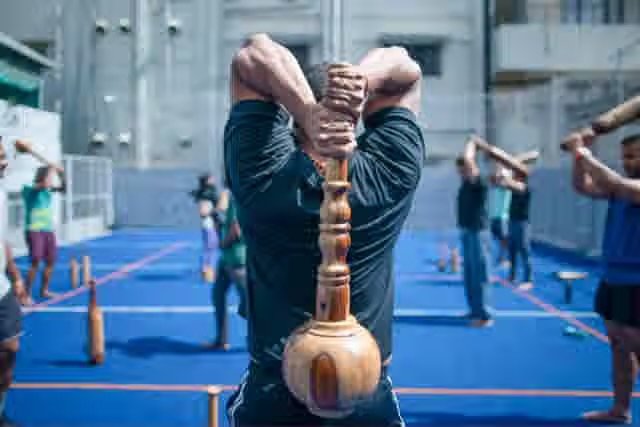
On a crisp morning in urban India, while millions head to air-conditioned gyms armed with protein shakes and fitness apps, Rishabh Malothra stands in a sunlit space holding what seems like an ancient weapon. A Hanuman Gada, a heavy wooden club, cuts through the air with practiced precision, engaging every muscle in his body. To the untrained eye, it looks like a relic from history, but in Malothra’s hands, it represents a radical revival of India’s forgotten strength-training traditions.
Malothra’s journey began with a personal challenge that changed the course of his life. A decade ago, he was the epitome of millennial fitness ideals—participating in ultra-endurance events, cycling from Kashmir to Kanyakumari, and traversing the European continent. His life revolved around pushing the limits of physical performance. Then came the devastating injury that left his left arm 75 percent paralysed due to a condition called Brachial neuritis. Conventional rehabilitation methods offered little relief, leaving him searching for an alternative path to recovery.
It was this search that led him to the ancient tools of Indian warriors. Malothra discovered a forgotten but profound system of strength training practiced for over a millennium. Three pillars became the foundation of his revival: the Hanuman Gada, the Mudgar, and the Santola. The Hanuman Gada, widely recognised, is a wooden club used to develop raw strength and endurance. The Mudgar, another club-like weapon, challenges coordination and builds explosive power. The Santola, known as the traditional Indian barbell, is used for conditioning and high-volume movements that target the arms and core.
What began as a method to restore his arm soon evolved into a movement capturing the imagination of soldiers, athletes, cricketers, women, and youth across India. The combination of these ancient tools and modern training principles provided a unique approach that was both functional and deeply rooted in India’s martial history. Malothra’s rehabilitation was not just physical; it became a philosophical shift in how strength, resilience, and fitness could be approached.
The training regime requires discipline and respect for the techniques passed down through centuries. Unlike conventional gym routines focused on isolated muscle groups, these traditional weapons demand full-body engagement, mental focus, and controlled movements. Each swing of the Hanuman Gada or Mudgar activates multiple muscle groups, enhances joint stability, and improves functional strength that can be applied in real-life movements. The Santola, with its high-volume exercises, conditions the body in a way that builds endurance, stability, and raw power simultaneously.
The appeal of this approach lies not only in its effectiveness but also in its cultural significance. For many, training with gadas and mudgars is a reconnection with India’s martial heritage, offering both physical benefits and a sense of identity. Schools, fitness enthusiasts, and even special forces have begun incorporating these exercises into their routines, blending ancient wisdom with contemporary training methods.
Malothra’s story also emphasizes resilience and reinvention. Facing the possibility of permanent disability, he turned to tradition rather than abandoning his passion for fitness. His experience highlights the potential of alternative approaches and the importance of exploring methods beyond modern, commercialized fitness trends. The rise of interest in these traditional practices shows that ancient techniques, when applied intelligently, can rival contemporary fitness methods and even surpass them in terms of functional strength and holistic conditioning.
Today, the movement inspired by Malothra is more than a personal recovery story—it is a fitness revolution. The sight of people swinging gadas, lifting Santolas, and practicing Mudgar routines in parks and gyms across India symbolizes a blend of discipline, heritage, and modern fitness ambition. It’s a reminder that physical strength is not just about aesthetics or machines but about control, endurance, and the integration of mind and body.
By revisiting the long-forgotten weapons of Indian warriors, Malothra has created a space where history meets fitness innovation. His work continues to inspire a new generation of athletes, fitness enthusiasts, and warriors of everyday life to embrace methods that challenge the body, cultivate resilience, and honour India’s rich martial traditions. The journey from injury to empowerment demonstrates that strength is not just physical—it is a mindset, cultivated through persistence, creativity, and respect for the wisdom of the past.
In every swing, lift, and controlled movement, the message is clear: Tagda Raho—stay strong, stay resilient, and reclaim the power that lies within, guided by the ancient tools and techniques that once forged warriors.